How Profitable Is a Waffle Business? Margins, Costs and Tips for Professionals
When people think about waffles, they often imagine pleasure, sweet aromas, markets, holidays or a warm treat enjoyed on the go. But today for many professionals (ice cream shops, crêperies, restaurants, food trucks, bakeries and coffee shops), waffles have also become a real profitability driver.
One question comes up again and again: “Is selling waffles really worth it?”
The answer is yes, provided it is done properly. In this article, we offer a clear and practical view based on field experience, with realistic figures and no exaggerated promises.
Waffles: a simple product with strong profit potential
At first glance, a waffle is a simple product. It usually involves:
- flour
- butter (sometimes margarine)
- milk
- eggs
- sugar
- a little technique
But in practice, waffles have one major advantage: a high perceived value for a relatively low production cost.
Let’s take a concrete example with the Belgian Liege waffle made with pearl sugar, a product that is very popular in Belgium, France and increasingly in international markets.

Belgian Liege waffles with pearl sugar
Controlled and predictable production costs
At AMPI, we work with professionals every day. Instead of staying in theory, we prefer to share figures based on real professional use. Here is the approximate ingredient cost of one waffle, depending on the dough ball weight, using our professional mix :
Waffle weight – Cost excl. VAT / waffle :
- 130g : 0,58€
- 100g : 0,45€
- 80g : 0,36€
- 60g :0,27€
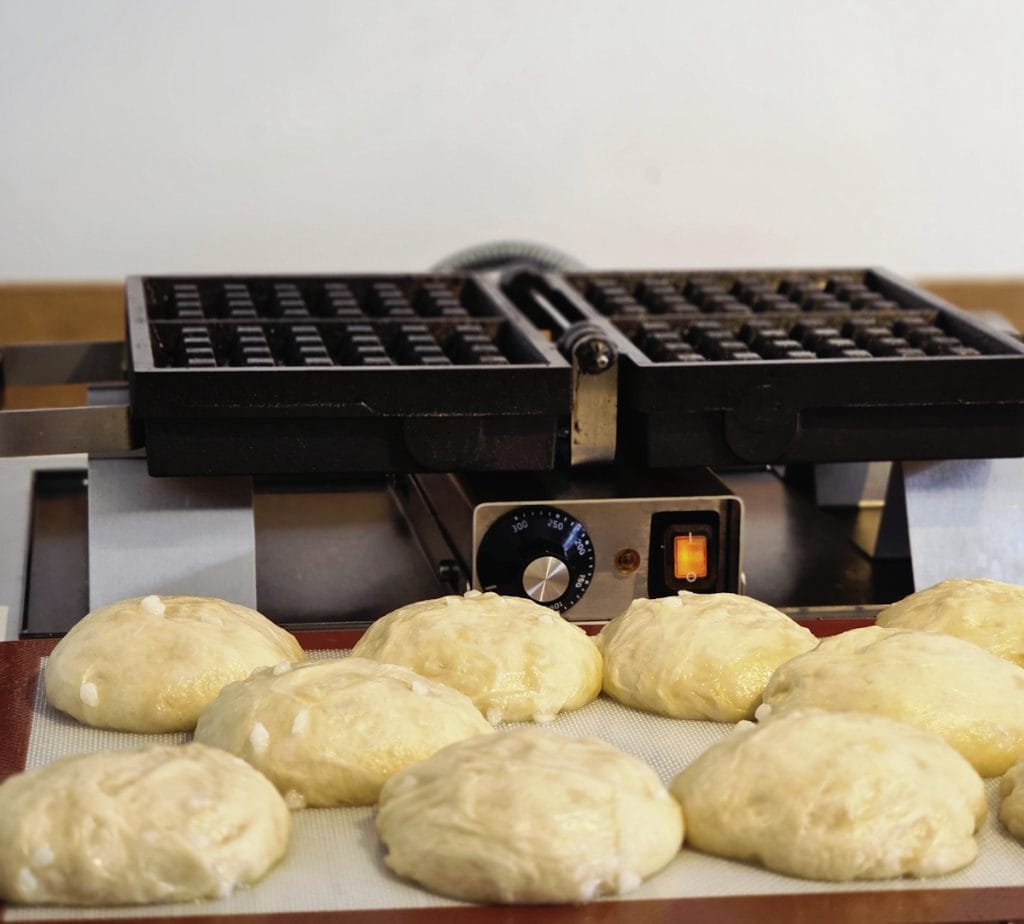
Waffle dough for Liege waffle
The key point is simple: the cost price of a waffle remains low, stable and easy to control.
For a professional, this is valuable because it makes it easier to :
- calculate margins
- anticipate costs
- organise regular production
- keep quality consistent
What about the selling price?
This is where waffles become especially interesting.
Today, in Belgium or France and many international markets, typical selling prices are:
- a plain waffle sells for between 3 € and 5 €
- a topped waffle sells for between 5 € and 8 €
- premium versions may exceed these prices, depending on the location and concept
Let’s take a practical example :
- A 130 g waffle sold for 4 €
- Production cost : ± 0,58 €
That leaves a gross margin of around 3,42 € per waffle.

Selling Belgian Liege waffle with pearl sugar
Of course, these figures also depend on other costs such as :
- staff
- energy
- rent or pitch fees
- general operating expenses
But even when these factors are included, waffles remain a highly attractive product for professional food businesses.
A practical example from the field
On a typical day, a professional working from a food truck, coffee shop or fixed point of sale, such as a crêperie or ice cream shop, might sell 100 waffles with an average selling price of 3 € to 4 €. This represents:
- Daily turnover : 300 to 400€
- Monthly turnover over 20 business days : 6000 to 8000€
Lors d’évènement (marchés, foires, festivals), certains clients atteignent : 300-400 gaufres vendues sur une journée.
During events such as markets, fairs or festivals, some professionals reach 300 to 400 waffles sold in one day.
These are not promises. They are realistic figures observed in the field. They help explain why Belgian waffles are now considered a strategic product in catering and food service.

Belgian waffles food-truck
The sensory advantage: the smell of freshly baked waffles
One advantage should not be underestimated: the smell of waffle baking.
The aroma of caramelising sugar acts almost like a magnet. It attracts attention, encourages customers to come closer and often leads to spontaneous purchases.
This sensory appeal is not limited to waffle sales. It can also help customers discover other products and increase the average order value. In a professional setting, the smell of fresh Belgian waffles can become a real commercial asset.
Waffle Mix, homemade dough or frozen dough balls: which solution should you choose?
This is a common question among professionals. Rather than defending only one approach, it is better to be transparent: each solution has its advantages.
Professional waffle mix: controlled quality and consistency
A professional waffle mix is a popular solution among food service businesses.
It saves time, helps control quality and ensures consistent results.
In practice, it helps to:
- simplify production
- reduce mistakes, especially with staff
- keep results regular
- control ingredient quality
Transport costs should still be taken into account, especially for export or high-volume operations.
Frozen dough balls: maximum simplicity
Some professionals prefer to buy ready-to-use frozen dough balls. This can be an interesting solution for small businesses or occasional activities as events.
The main advantage is simplicity. However, frozen transport and storage costs are generally higher, and there is less room for customisation.
You can contact us if you are looking for frozen waffle dough suppliers. We know several well-established and reputable companies in Belgium.
Frozen Liege waffle dough
Homemade dough: economical but demanding
Making your own dough is perfectly possible. However, it requires:
- a reliable Belgian Liege waffle recipe
- consistency
- time
- good organisation
Ingredient quality, especially butter and flour, can vary significantly from one country to another. This can directly affect the final result.
Can you make a living from selling waffles?
It is a legitimate question. The answer is simple: yes, it is possible. But like any professional activity, success depends on several factors:
- location
- sales volume
- product quality
- organisation
- customer experience
In practice, some professionals make waffles their main business, while others use them as a highly profitable addition to an existing activity.
A real opportunity… if done properly
Waffles are not a magic product. But when well managed, they can become an excellent profitability lever.
What makes the difference is not only the recipe. It is the whole system:
- the product
- the equipment
- the workflow
- the customer experience
- the ability to produce regularly during busy periods
Waffles are also highly versatile. An ice cream shop can use them to increase sales in winter. A creperie can diversify its offer. A food truck can build a complete concept around Belgian waffles.
Why professional waffle equipment matters
In professional food service, consistency is essential. A professional waffle maker can make a major difference.
A professional electric waffle iron allows you to:
- bake intensively and consistently
- produce quickly
- manage busy service periods more efficiently
- maintain quality during rush hours
In the end, good equipment mainly allows you to produce more without sacrificing quality. And that means more satisfied customers.
Do you have a waffle business project?
At AMPI, we support professionals every day: food businesses, ice cream shops, food trucks, coffee shops, creperies, bakeries, restaurants and entrepreneurs developing a project around waffles.
Our approach is simple: to offer a complete solution adapted to real professional conditions. We focus on three essential areas:
Belgian Waffle Makers
Robust, efficient machines designed for intensive professional use.
Waffle Ingredients
Professional mixes and solutions created to help guarantee regularity and quality.
Waffle training
Training to help you master production, optimise your organisation and improve profitability.
Whether you are just starting to think about your project or already selling waffles, AMPI takes the time to understand your needs and guide you towards the most suitable solution.
Conclusion
Selling waffles can be a highly profitable opportunity for food professionals when the product, equipment and organisation are well chosen. With Belgian expertise, robust cast iron waffle makers and professional support, AMPI helps you build a reliable and profitable waffle activity.
Discover our solutions or contact us on AMPI.BE for personalised advice.
Ampi.be apron for baking waffles